

Partner Spotlight: Why the UAE is raising the bar for passenger information
Chadi Farran is the Business Development Manager at Energy International, a transportation systems integrator working…
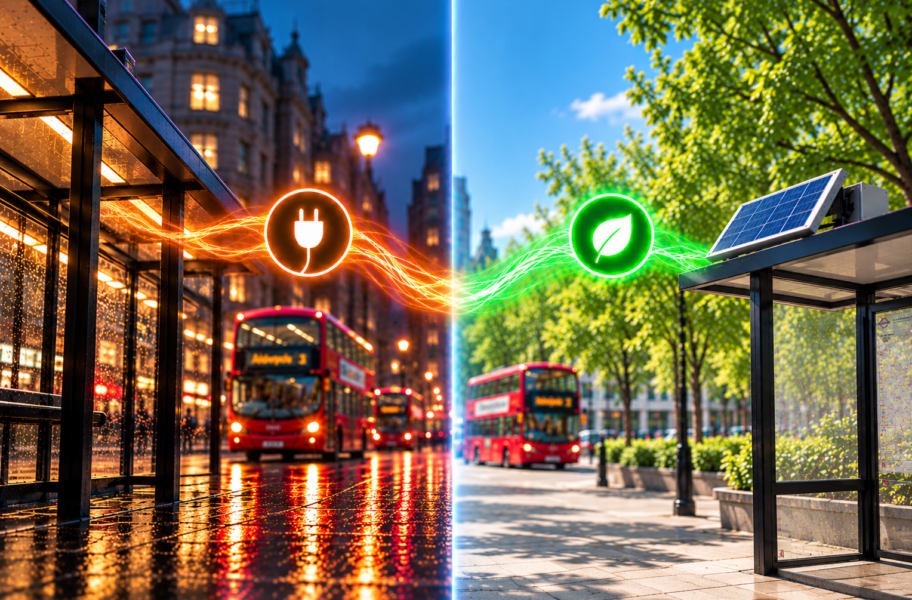
As transit operators modernise passenger information infrastructure, power consumption is becoming a much bigger consideration.
It’s no longer just about displaying information. Operators are balancing sustainability targets, rising energy costs, infrastructure complexity and long-term operational efficiency – while also looking for ways to deploy new passenger information infrastructure faster and with less disruption.
That’s where e-paper works very differently to traditional display technologies.
So what does that difference look like in practice?
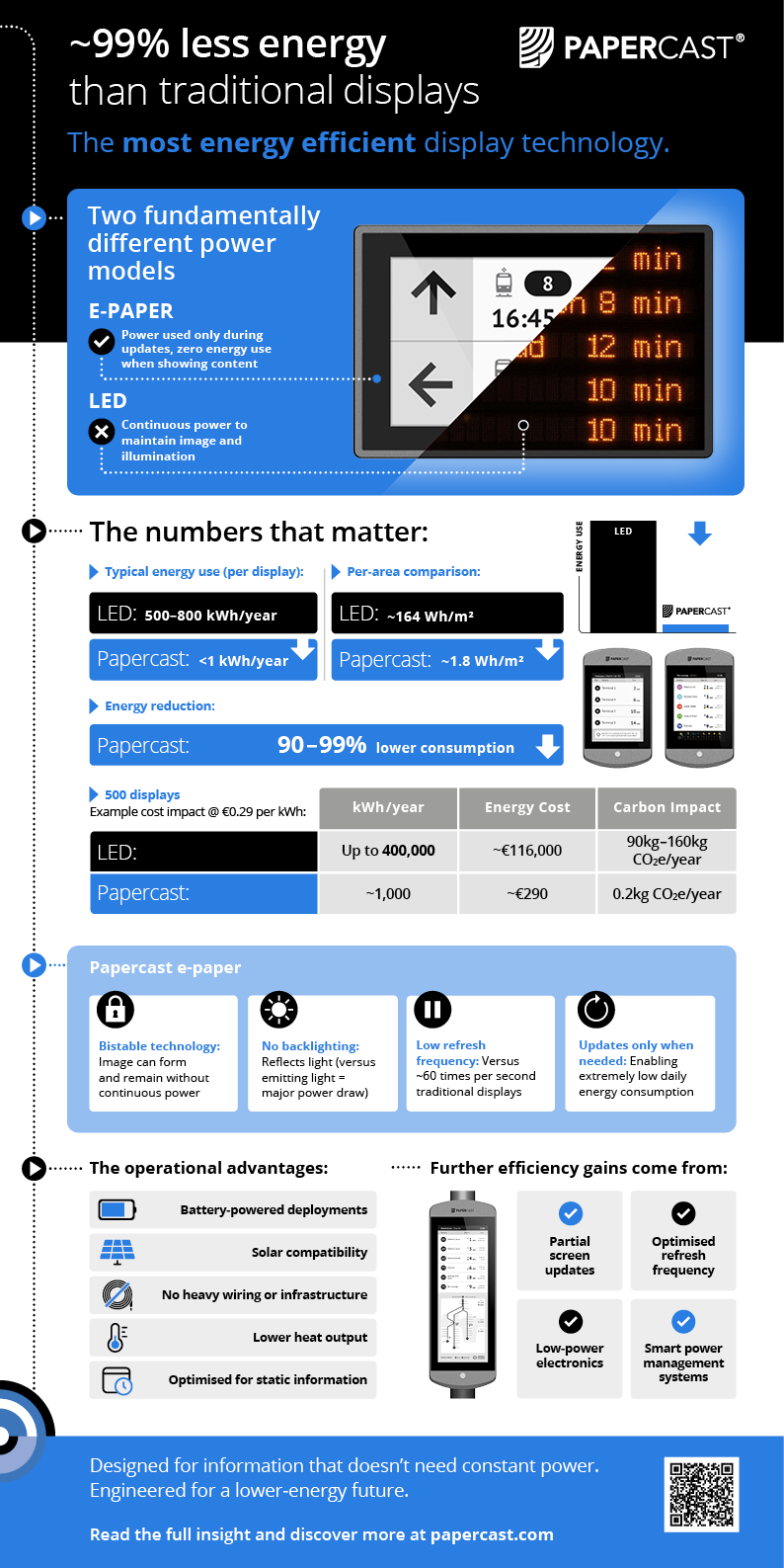
The infographic below highlights some of the key differences between traditional LED displays and e-paper technology, from annual energy consumption and operating costs through to carbon impact, installation speed and deployment flexibility.
It provides a useful snapshot of why power efficiency is becoming such an important consideration for transit operators.
Traditional LED displays require continuous power to maintain an image, refresh the screen and provide illumination – even when content remains unchanged.
E-paper works differently.
Power is only used when content updates. Once displayed, information remains visible without continuous energy consumption.
That fundamentally changes the energy profile of the display and is one of the main reasons e-paper is regarded as one of the lowest power display technologies available today.
The energy savings become significant at network scale.
Traditional LED signage can consume between 500–800 kWh per display per year. Papercast e-paper displays consume less than 1 kWh per year.
Across larger passenger information networks, that can have a major impact on:
Based on the infographic analysis for a 500-display deployment, the electricity usage costs alone are estimated at:
As networks scale, the operational and sustainability benefits scale with them.
Reducing power consumption at this scale can also significantly reduce the operational carbon footprint of passenger information networks.
Traditional LED signage can consume around 500x more energy that e-paper. By choosing e-paper, operators can reduce both electricity usage and associated operational emissions across large-scale deployments.
As networks scale, the sustainability benefits scale with them.
Because e-paper requires so little power, displays can often operate using solar and battery power rather than fixed electrical infrastructure.
This can dramatically simplify and accelerate installation. With no need for extensive trenching, cabling or new power connections, displays can be deployed quickly in locations where traditional digital signage may be difficult, expensive or impractical to install.
For operators rolling out displays across multiple stops or locations, faster installation can help accelerate deployment programmes while reducing disruption and infrastructure requirements.
The display technology is only part of the story.
Overall power efficiency is also influenced by system-level design, including:
Combined together, these capabilities help minimise total energy consumption while still delivering real-time passenger information.
As transit networks continue to modernise, display technology is increasingly being evaluated not just on visibility and functionality, but on how quickly and easily it can be deployed, its infrastructure impact, operational efficiency and long-term sustainability.
Chadi Farran is the Business Development Manager at Energy International, a transportation systems integrator working…

The problem is no longer which display to buy. It is how to manage all…