
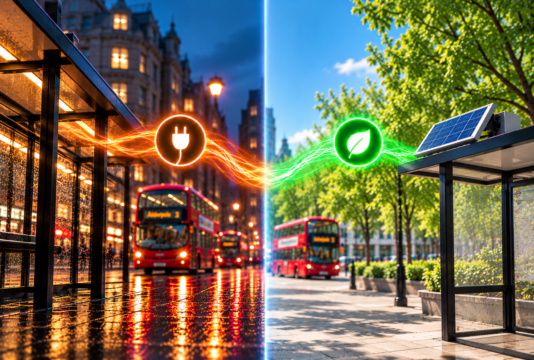
The power advantage of e-paper display technology
5 things you need to know. As transit operators modernise passenger information infrastructure, power consumption…

IT-TRANS 2026: A reality check on passenger information
By David Barker, CEO, Papercast
A few months into my role as CEO at Papercast, IT-TRANS 2026 offered a useful vantage point. The conversation around passenger information has moved on.
Across the exhibition floor and congress programme, several themes were unmistakable: AI and data normalisation, cybersecurity and resilience, demand-responsive transport, energy efficiency and decarbonisation, and above all, delivering better services within constrained budgets.
But what struck me most was this: while technology is accelerating rapidly behind the scenes, the passenger’s expectations are unwavering. They want certainty. They want visibility. They want trust. And that makes passenger information more strategic than ever.
Transit authorities are no longer asking whether they need real-time passenger information. That debate is over. It’s becoming embedded in the fabric of a modern bus network. The question now is: how do we deliver it everywhere, consistently, sustainably and without creating new operational burdens?
Information at the bus stop directly affects a passenger’s decision to wait, reroute or abandon a journey. If it is unclear or absent, confidence drops immediately. Numerous studies have repeatedly shown that access to accurate, real-time information improves perceived service quality and increases passenger confidence, with measurable improvements in satisfaction and ridership growth. The bus stop remains one of the most influential physical touchpoints in public transport. The industry understands this.
What has changed is the scale of expectation.
One of the strongest threads running through IT-TRANS was network-wide digitalisation.
Historically, passenger information displays have often been deployed selectively at high-footfall locations; wider deployment constrained by power access, infrastructure cost or technology limitations. That model is increasingly difficult to defend.
The focus was no longer on isolated innovation or proofs of concept, but on implementation of new technologies across entire networks. Once deployment moves to that scale, constraints become visible. Energy demand matters. Installation complexity matters. Ongoing maintenance burden matters.
Delivering information at scale – and doing so sustainably – is now the defining challenge.
The sustainability conversation at IT-TRANS felt materially different this year; less aspirational and more operational reality.
Transport authorities are balancing decarbonisation targets with rising energy costs, ageing infrastructure and political pressure to modernise services. Energy efficiency is no longer a CSR talking point; it is an operational requirement.
Transportation accounts for nearly a quarter of global CO₂ emissions. In that context, every element of infrastructure is under scrutiny, including passenger information systems.
Digital infrastructure that requires trenching, mains power upgrades and ongoing energy consumption simply does not scale easily across entire networks. Deploying it across hundreds or thousands of stops becomes difficult to justify.
This is one of the reasons e-paper technology continues to gain traction. Because it changes the deployment equation. Ultra-low power, solar or long-life battery operation, wireless connectivity and retrofit capability mean digital passenger information can extend beyond city centres into suburban and rural stops; without the civil works that historically made network-wide rollout prohibitive.
Another recurring theme was integration and estate complexity.
Many operators are now managing a patchwork of technologies introduced over time. Mixed hardware estates. LED, LCD and e-paper. Legacy platforms and newer digital solutions. Siloed systems rolled out over the last decade and beyond.
The challenge is not the existence of these different technologies. It is the operational friction that comes with managing them coherently.
A passenger does not care what technology is behind the display. They care that the information is clear and accurate. For the operator, however, the architecture behind that display determines cost, maintenance burden and long-term flexibility.
In my discussions at the event, it was clear that authorities are looking for vendor-agnostic, purpose-built management platforms that give them estate-wide visibility and control; not another closed ecosystem.
Digital maturity in public transport is moving beyond devices. It is about governance, integration and operational oversight.
Ridership came up frequently in discussions.
Rebuilding and sustaining public confidence in public transport remains a priority across markets. Technology plays a role here in a very tangible way.
Clear, high-contrast, readable real-time information reduces perceived waiting time and lowers anxiety. Research demonstrates that access to live information increases tolerance for delay and improves overall satisfaction.
We have seen in independent trials that even when identical arrival data is presented, the use of more modern technologies (e-paper) and the presentation of information changes how passengers feel about the service.
Design, visibility and accessibility influence trust. As an industry, we sometimes underestimate that emotional dimension.
As Papercast enters its next phase of growth, my perspective is simple. Passenger information must be:
The conversations at IT-TRANS confirmed that transit authorities worldwide are not chasing novelty. They are looking for pragmatic, proven solutions that align passenger experience, sustainability and operational efficiency.
The role of e-paper in that landscape is not about replacing one display type with another. It is about enabling digital passenger information to exist where it previously could not; sustainably and at scale.
For me personally, only months into this role, IT-TRANS reinforced something fundamental. Progress in public transport is not measured by the sophistication of technology alone. It is measured by what the passenger sees at the stop, in the moment they decide whether to trust the service.
If we get passenger information right – at every stop, for every rider – we strengthen the attractiveness and resilience of public transport itself. And that remains the bigger mission.
5 things you need to know. As transit operators modernise passenger information infrastructure, power consumption…

Chadi Farran is the Business Development Manager at Energy International, a transportation systems integrator working…